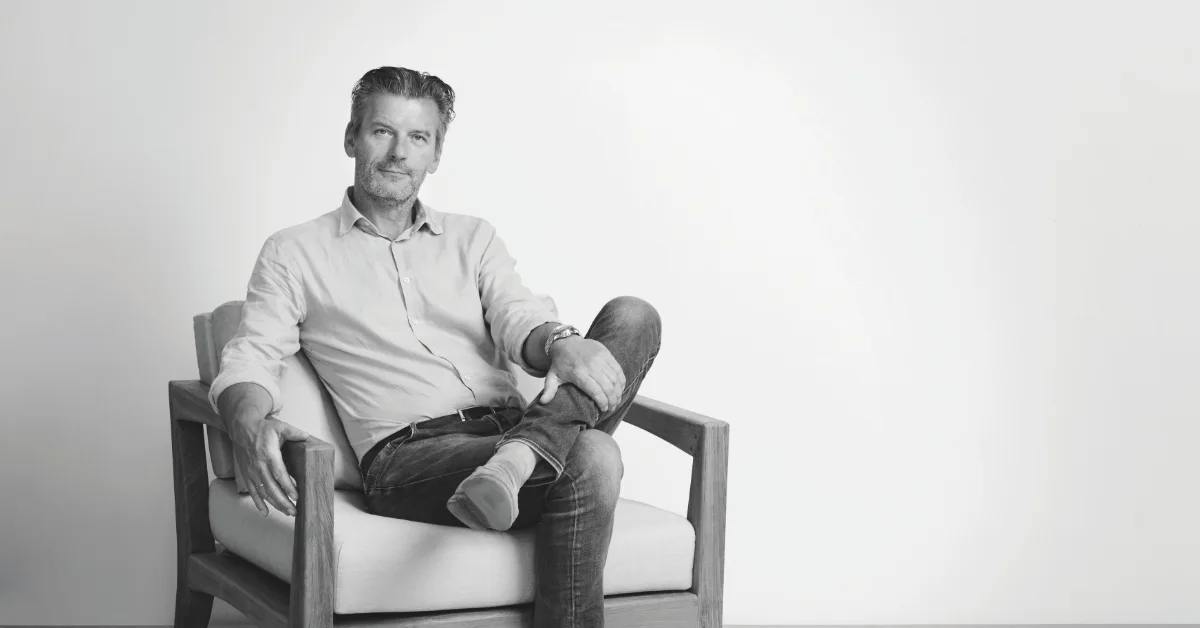
Royal Botania sells some of the most coveted outdoor furniture in the world, and it does so from an unlikely headquarters in Belgium rather than one of the design capitals its rivals call home. The company's advantage, according to its founder Kris Van Puyvelde, comes down to a stubborn insistence on doing almost everything itself, from the first pencil sketch of a chair to the research that turns an idea into a product no one else can copy.
Building a global brand from Belgium is something I am deeply proud of, Van Puyvelde says, and the pride is earned. An engineer by training, he still runs both the company and its creative direction, now alongside his son Pieter, and he has spent more than three decades turning a side project into a fixture of high end gardens, terraces, hotels, and yachts.
From a weekend sale to a global brand
The origin story is almost accidental. In 1992, Van Puyvelde and his co-founder Frank Boschman began importing teak furniture from Indonesia after spotting it at a trade fair, then organized a casual weekend sale for friends and acquaintances. It sold out completely. That reception convinced the pair there was a real market, and rather than keep reselling other people's pieces they set about designing their own.
From the start the aim was to look different. The company pushed toward lighter, more ergonomic furniture and kept changing the materials underneath it, moving from teak to combinations of wood with stainless steel and aluminum, then to pieces made entirely of metal, and now to a wide palette of materials chosen design by design. We have always been pioneers in innovation, bringing something different to the market, Van Puyvelde says.
Everything under one roof
What sets Royal Botania apart, in his telling, is that it behaves as an A to Z company, controlling design, prototyping, production, and sales rather than farming the work out. Everything, from the first sketches to after sales service, happens in house, he says. Most of our competitors outsource everything to external manufacturers, often in China. We have full control over the production process.
That control runs through the company's own factory in Thailand, opened in 2002, which lets it prototype quickly and police quality in a way rivals cannot. The payoff showed up last year at the design world's biggest stage. Royal Botania won two Red Dot Design Awards, for Product Design and for Innovative Design, both for the Anamon, an inventive parasol that opens from a slim tube and doubles as a lamp when closed. Its prototype became a sensation at the Salone del Mobile in Milan, racking up more than 500 million views and 8 million likes.
A powerhouse with a client list to match
The brand has been present on every continent since 2011, though its sales still lean heavily on home turf, with roughly 75 percent coming from Europe, 20 percent from the United States, and the remaining 5 percent scattered across other markets. It shows its work at The Glasshouse, a showroom in Wommelgem that opened in 2024, and at a design center in New York that has operated since 2009. Its furniture has found its way to the King of Morocco, Bruce Springsteen, and the Dutch royal couple, as well as luxury hotels and yachts.
The path is not without hazards. Van Puyvelde points to geopolitical conflict in Russia, Ukraine, and the Middle East that has disrupted key markets, to United States import tariffs eating into sales, and to a wave of established interior design brands trying to muscle into the outdoor category. He is unbothered by the newcomers. These are often interior brands that lack the know how to make outdoor products, he says.
Do your own thing
For Van Puyvelde, the through line of the whole venture is temperament rather than strategy. If you want to excel at something, you need passion, he says, and his advice to would be entrepreneurs is of a piece with how he has run Royal Botania. Find your passion and go after it, he says. It is the best driving force there is for achieving results. And above all, do your own thing, without looking too much at others. That refusal to follow, he insists, is the source of the company's originality. We do not look too much at what others do, we do our own thing, he says. It is ingrained in our DNA, and that is where we draw our originality from.