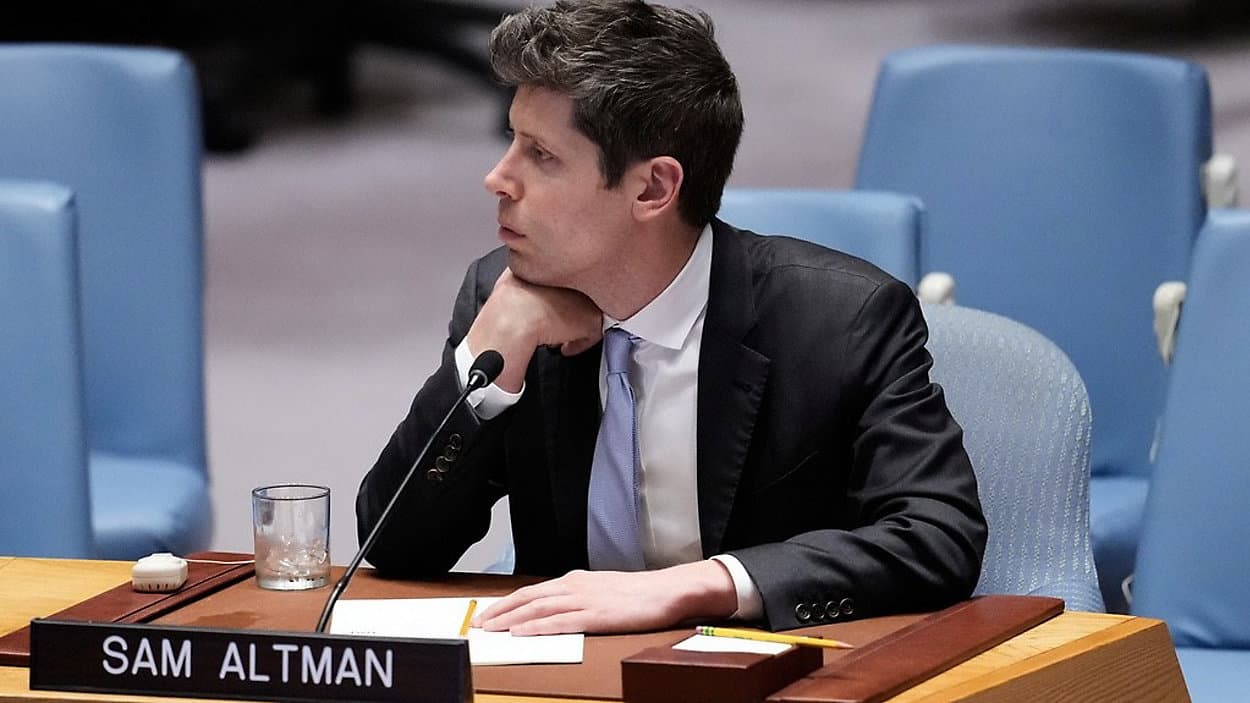
Sam Altman took his case for global AI governance to one of the world's most powerful diplomatic bodies this week, briefing the United Nations Security Council on the risks posed by increasingly capable artificial intelligence systems.
The OpenAI chief executive appeared in New York alongside a small group of other prominent voices in AI, including Hugging Face chief executive Clement Delangue and Yoshua Bengio, the Montreal based researcher who co-chairs the UN's Independent International Scientific Panel on AI. Anthropic chief executive Dario Amodei took part remotely rather than appearing in person. The session marked one of the highest profile efforts yet to bring frontier AI developers directly into discussions traditionally reserved for matters of international peace and security.
A Case for Shared Global Standards
Altman used the appearance to push for coordinated national and international standards governing the most advanced AI systems, arguing that voluntary, company by company approaches to safety are no longer sufficient given how quickly the technology is advancing. He argued that even a small probability of a catastrophic outcome from AI is not something society should accept, whether that risk is estimated at 10 percent or as low as one tenth of one percent.
He went further, suggesting that AI developers should hold themselves to a strict internal standard before releasing powerful new models, saying companies should not train systems at all unless they can make a credible case that those systems will remain under human control. That framing puts pressure on OpenAI and its rivals to demonstrate safety measures publicly rather than relying on internal assurances.
Diplomacy Meets the AI Race
The Security Council briefing reflects growing recognition among world governments that the companies building frontier AI models now hold outsized influence over global technological and economic trajectories, influence that traditional diplomatic institutions have struggled to fully absorb into their usual processes. Bringing together competing AI labs, an independent scientific panel, and the Security Council itself signals an attempt to build a shared factual and safety baseline before governments settle on binding rules.
Whether the session produces concrete follow through remains to be seen, but the willingness of leading AI executives to appear before the council, and to speak in terms of catastrophic risk rather than purely commercial opportunity, underscores how central AI safety has become to global policy discussions less than four years after the technology's most recent wave of rapid public adoption began.