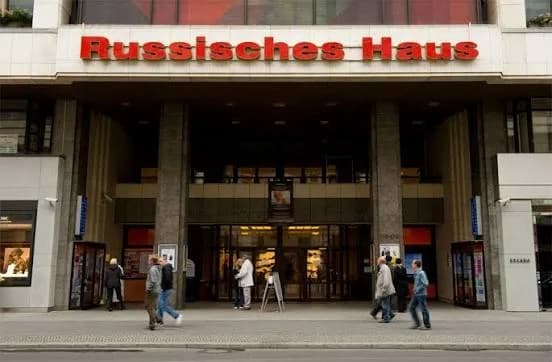
On Friedrichstrasse, one of Berlin's busiest cultural boulevards, a large sign reading Russisches Haus marks the entrance to a building that Moscow presents as a friendly window onto Russian language, art, and culture. To a growing number of German politicians and security analysts, however, the Russian House is something less benign, a state run outpost they suspect of doubling as a base for propaganda and espionage in the heart of the German capital.
The center is operated by Rossotrudnichestvo, the Russian government agency responsible for cultural ties with Russians living abroad. On paper its mission is soft power in the gentlest sense, exhibitions, language classes, film screenings, and events for the diaspora. Critics argue that the same activities provide convenient cover, using art and education to promote the idea of a Russian world while quietly advancing the Kremlin's political aims.
A sanctioned agency with an open door
The European Union has already taken a hard view of the organization behind the house. In July 2022, months after Russia's full invasion of Ukraine, the bloc placed Rossotrudnichestvo under sanctions, describing it as the Kremlin's main instrument for exerting hybrid influence and for spreading historically revisionist narratives. The listing froze the agency's assets across the EU.
Yet the Berlin branch has kept its doors open, an awkward situation in which an entity under EU sanctions continues to run a prominent public venue in a member state. That contradiction is a large part of why the house has become a lightning rod, and why lawmakers keep returning to a single question, whether a sanctioned arm of the Russian state should be allowed to operate so visibly on German soil.